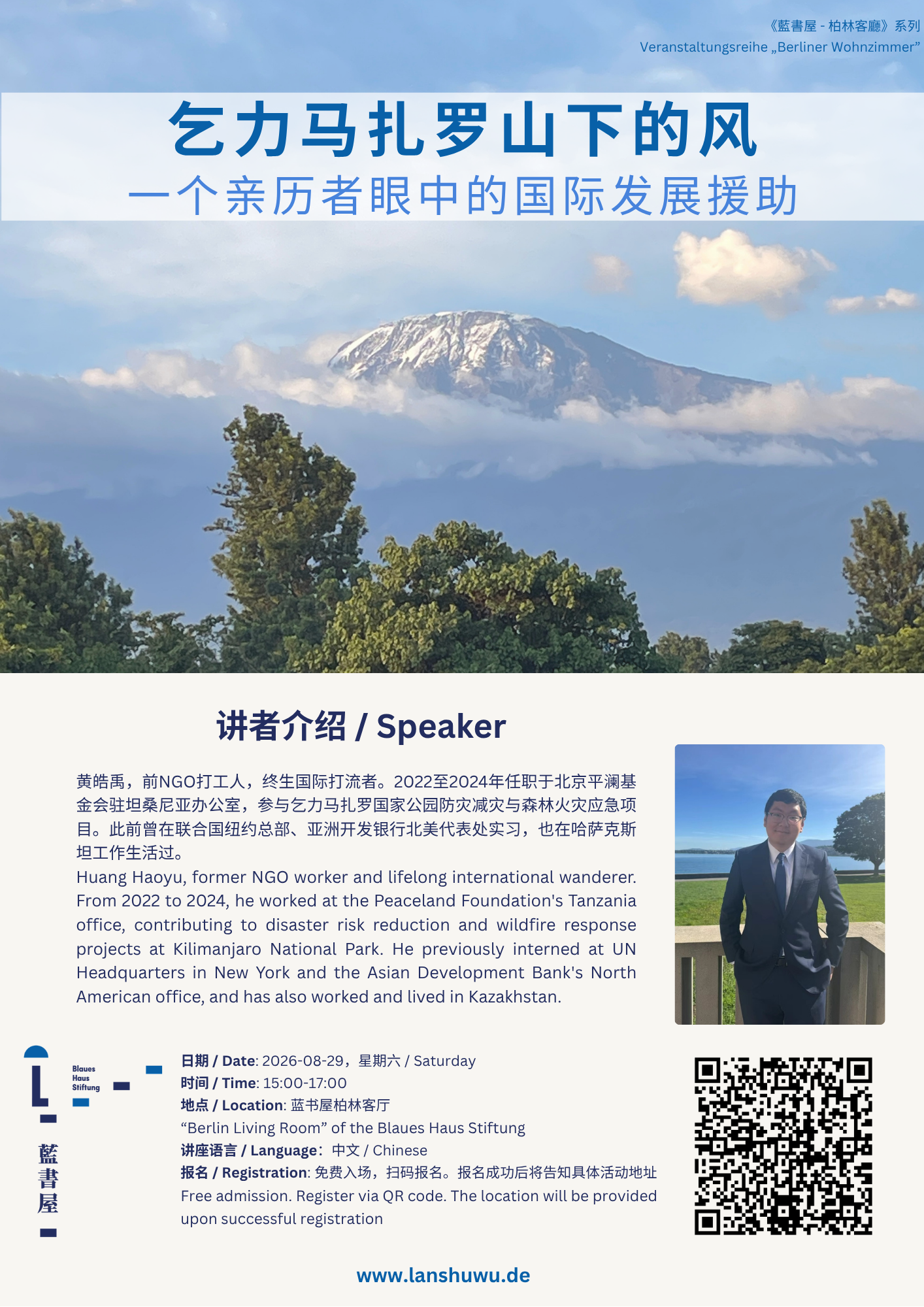
At the foot of Mount Kilimanjaro, mountain tourism brings a steady stream of visitors and considerable income to the town of Moshi, but it also exposes the fragile livelihoods of local residents, escalating climate risks, and the complex realities of international development aid.
On August 29th, the Blue Bookstore’s „Berlin Living Room“ invited Haoyu, who previously worked in development aid in Tanzania, to discuss with Jiayu, who also has experience living and working in Africa. They will begin by recounting their encounter in Moshi, discussing life in the small town beyond the tourism narrative, and the firsthand experience of an international development aid worker: how to build trust with local communities and government agencies, and how aid projects are affected by funding, institutions, and the international situation.
They also hope to explore with the audience: as the global development aid industry experiences a sharp contraction, what dilemmas and possibilities do young people—especially young Chinese people—face?
The following is an introduction to this sharing session by Jiayu, one of the speakers at the event.
Hello everyone, I’m Jiayu. This sharing session started with the wind at the foot of Mount Kilimanjaro.
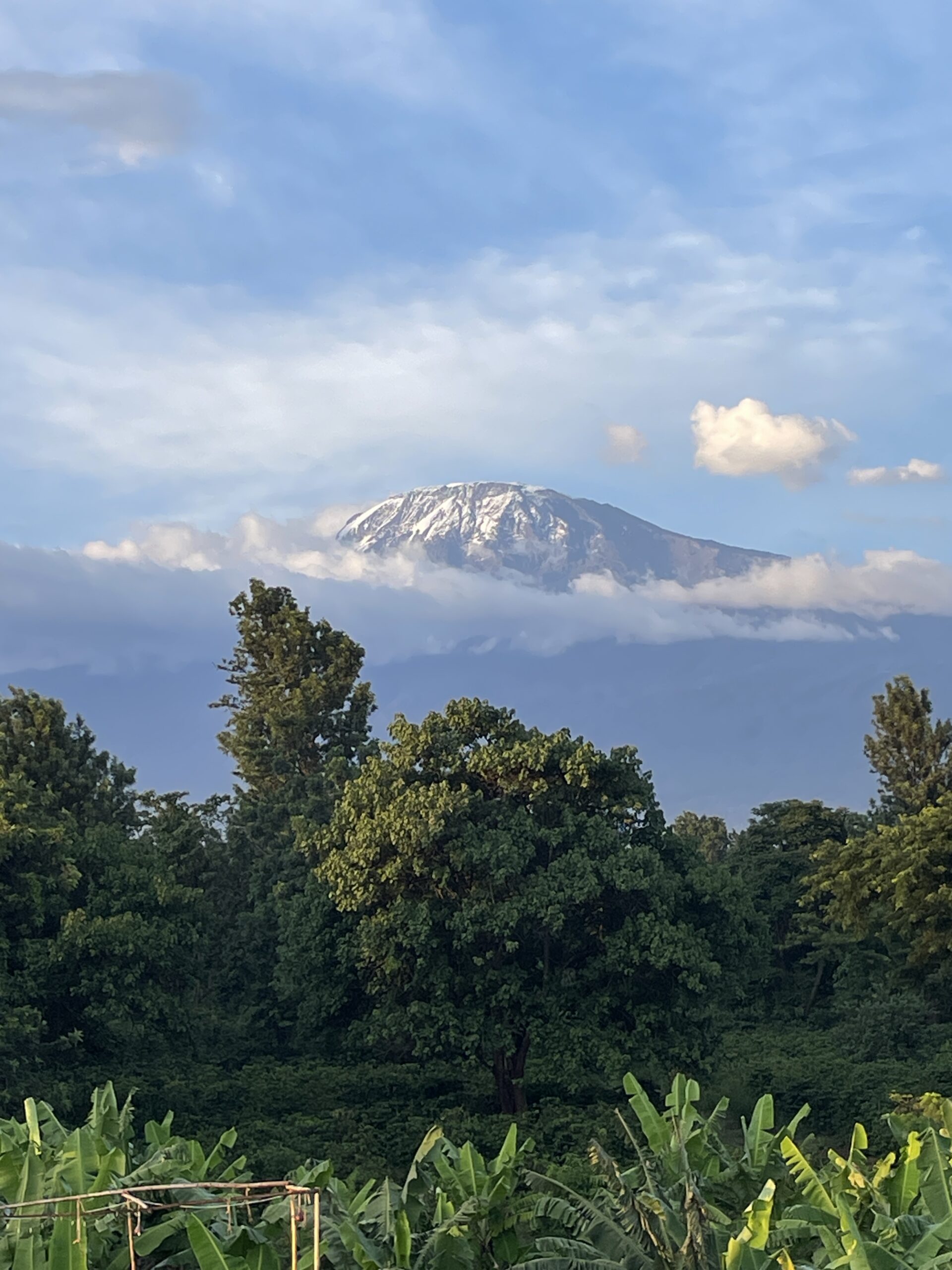
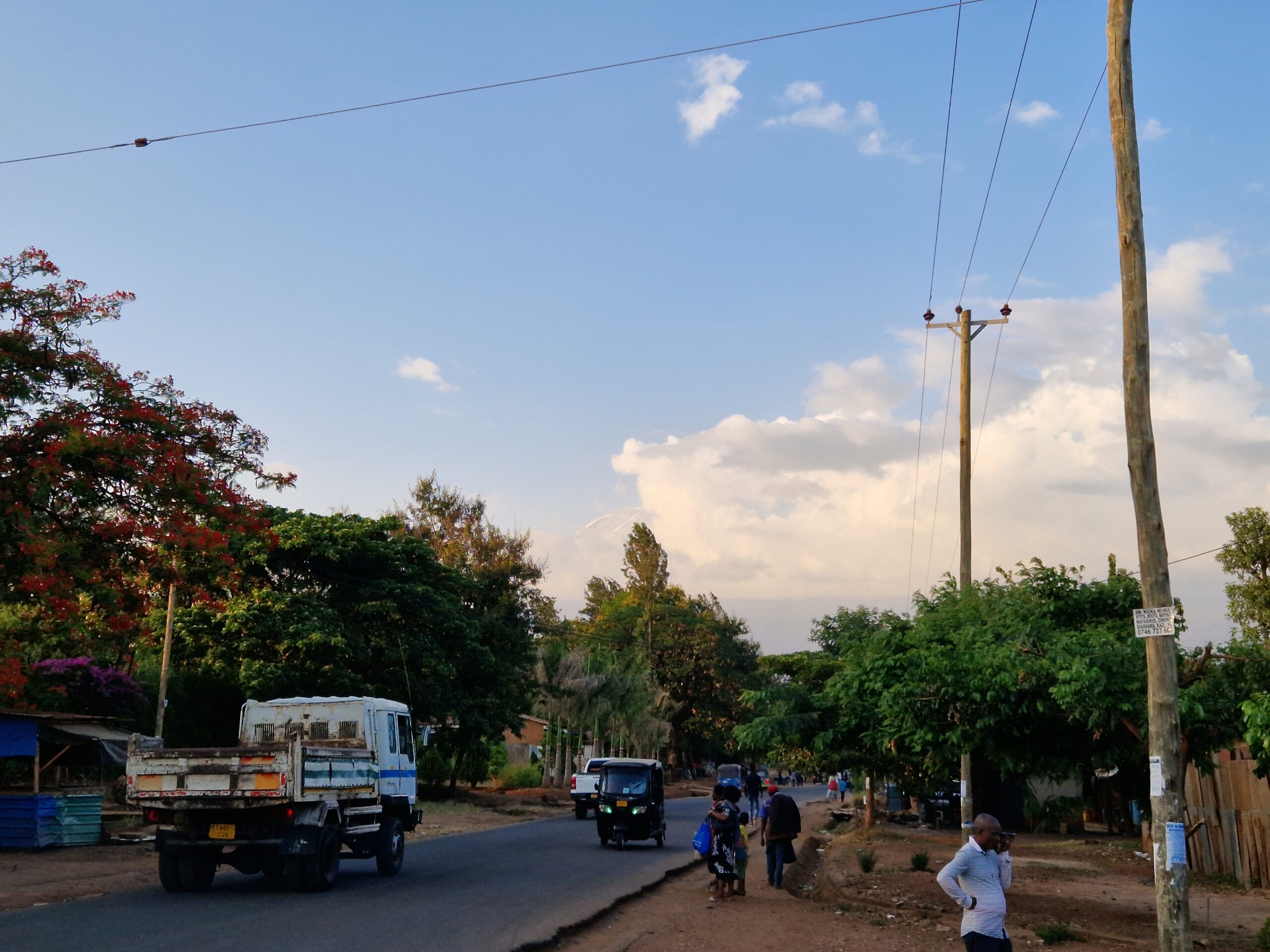
The wind at the foot of Mount Kilimanjaro is strong. Dust is blown into every corner of the room, and clothes drying on the floor are always covered with a layer of fine sand. As a necessary stop on the way to climb Mount Kilimanjaro, this place is always bustling with tourists from all over the world, and the dust kicked up by their jeeps.
This is Moshi, a small town at the foot of Mount Kilimanjaro. Moshi is located in northeastern Tanzania and is picturesque. On a clear day, you can see the towering Mount Kilimanjaro and its snow-capped peak from the window. This is Moshi, and also where I met Haoyu.
From 2022 to 2023, I interned at an international development aid agency in Kigali, the capital of Rwanda, assisting the local government in promoting digital transformation, as well as artificial intelligence projects such as large language model development and natural disaster monitoring. In my spare time, I also enjoy solo backpacking trips, exploring different towns and countries.
Through a friend’s introduction, I met Haoyu, who was also working on a development aid assignment in Tanzania. At that time, he had been stationed in Moshi for almost two years on behalf of an NGO, primarily involved in local disaster prevention and mitigation projects, and assisting local government agencies—from Kilimanjaro National Park to emergency services—with personnel training and material donation coordination.
In February 2023, on the last leg of my trip to Arusha, Tanzania, I visited Moshi and finally met Haoyu. He showed me around the town, introducing me to the local customs and anecdotes about the projects. We also exchanged our work and industry observations.
Moshi is both the gateway town for climbing Mount Kilimanjaro and the ancestral home of the Chagga people. The Chagga culture is closely intertwined with this highest peak in Africa; Mount Kilimanjaro holds both economic and spiritual significance for them.
The town’s economy relies primarily on coffee cultivation and mountain tourism. Approximately 50,000 people set off annually to attempt to summit Kilimanjaro. A standard seven-day trek typically costs between $2,500 and $3,500, almost equivalent to several years‘ income for an average local family. However, most of this money goes to international travel agencies, park entrance fees, and logistical costs. The local porters who actually carry the climbers‘ luggage, set up camp, and prepare meals often earn only $10 to $15 per day, and most lack formal employment contracts.
Moshi’s not-so-cheap prices coexist with the reality of many residents struggling to make ends meet—many rely on informal economic activities such as street vending and odd jobs to support their families, with meager and highly unstable incomes. In villages not far from Moshi, some elderly people even live on as little as $5 or even $1 a month.
Meanwhile, the Kilimanjaro region is also at the forefront of climate change. In recent years, the extreme rainfall brought by El Niño has repeatedly triggered severe floods and mudslides in Moshi and the surrounding areas, as well as Arusha, the base of the Serengeti National Park, causing casualties, damage to roads and bridges, and reduced agricultural yields. The glaciers on the mountaintop are also retreating rapidly.
Locals often say that the timing and amount of the rainy season are no longer as predictable as before, and the agricultural system upon which the Chaga people depend for their livelihood is becoming increasingly unstable. Meanwhile, despite high ticket revenue, Kilimanjaro National Park still lacks the basic supplies and facilities needed to cope with forest fires and floods. The booming tourism industry, the fragility of local livelihoods, and the increasingly severe risks of natural disasters intertwine to form the complex reality that Haoyu and his colleagues must confront when carrying out disaster prevention and mitigation work in the area.
During my brief two-day stay in Moshi Town, I experienced the not-so-low prices, the constant stream of hikers, the struggling local villagers, and their fragile resilience to natural disasters. As a crucial stop on the route to climb Mount Kilimanjaro, a significant tension exists between the booming tourism industry and the actual lives of local villagers: who benefits from tourism, and who bears the burden of climate risks and living costs? This involves a complex web of relationships between land, employment, external aid, and local governance—even the relationship between local communities and national park management is not without friction.
Back in Rwanda, I continued my internship while observing and comparing the situations in both countries. During the rainy season, Rwanda, the land of a thousand hills, also faces increasingly severe natural disasters such as floods and mudslides. One of my projects was related to disaster early warning. Later, after my year-long internship, I returned to Berlin to continue my studies; Haoyu soon resigned from his job and also came to Berlin to pursue a master’s degree, and that’s how we met again in Berlin.
Therefore, this time, I’d like to invite Haoyu to the „Berlin Living Room“ at Blaues Haus to have a good chat with him:
What was his daily life like during his long-term stay in the town of Moshi? How did an outsider gradually integrate into the local community, and what lonely, interesting, or unexpected moments did he experience?
What unforgettable experiences did he have while participating in development aid projects in Tanzania, and who were the people who impressed him the most?
As a development aid worker from a foreign country, what misunderstandings, trust-building, and tensions did he experience when dealing with local people, village and town leaders, and local government agencies?
What has become of the development aid projects he participated in after his departure, and with aid funds becoming increasingly scarce?
Meanwhile, in recent years, the international development aid sector has experienced tremendous turmoil. This sector has long suffered from many structural problems, such as short project cycles, reliance on external funding, and a large number of positions existing as unpaid or low-paying internships, making it difficult for many young people without financial support to enter this field.
Coupled with the pressures of a turbulent international situation and economic recession, governments worldwide are cutting foreign aid budgets. In 2025, the US government shut down USAID (United States Agency for International Development), terminating over 90% of its projects and thousands of contracts and grants. US foreign aid spending was halved compared to the previous year. This change is almost fatal to the entire aid ecosystem. Meanwhile, major European donor countries such as Germany, France, the UK, and the Netherlands have also significantly reduced their development aid budgets in the past two years. UN agencies have been forced to lay off staff and scale back projects due to budget shortfalls.
Job opportunities across the industry are rapidly decreasing. Many practitioners are forced to change careers; many young people and graduates who held idealistic beliefs and passions for this profession are finding that this once clear career path is becoming increasingly narrow and unstable, often requiring multiple unpaid or low-paying internships just to barely enter the industry.
Finally, we hope to use this sharing session to discuss with everyone: what has this upheaval sweeping the entire industry brought to practitioners and idealistic young people; what difficulties and possibilities do young people, especially young Chinese people, face in the international development aid industry, which is undergoing severe turmoil and is dominated by Western countries, and what are the possibilities?
Speaker
Haoyu, former NGO worker, lifelong international wanderer (drifter). From 2022 to 2024, he worked at the Beijing Pinglan Foundation’s Tanzania office, working daily with local government and national park management agencies on various projects—helping Kilimanjaro National Park deal with forest fires, providing training to local volunteers on human-wildlife conflict and disaster prevention and mitigation, and gradually getting to know the real situation in this place through daily interactions with the locals. Before coming to Tanzania, he interned at the United Nations Headquarters in New York and the Asian Development Bank’s North American Representative Office, and also lived in Kazakhstan for a period of time.
Event information
Date: Saturday, August 29, 2026
Time: 15:00-17:00
Event location: Blue House Berlin Living Room (specific location information will be sent after successful registration)
Language: Chinese
Registration: Free admission. As space is limited, those wishing to join this event are invited to scan the QR code below and complete the registration questionnaire. Once successfully registered, we will send the event details to your email address. Please understand that we may not be able to reply if you are not selected.